Close Get email notifications on {{subject}} daily! Your notification has been saved. There was a problem saving your notification. {{description}}Email notifications are only sent once a day, and only if there are new matching items.
Close Get email notifications on {{subject}} daily! Your notification has been saved. There was a problem saving your notification. {{description}}Email notifications are only sent once a day, and only if there are new matching items.
The announcement resulted from the visit of an Italian delegation led by Stefano Gatti, Director-General for Development Cooperation, to the Ministry of Finance. The visitors met with State Finance Ministers Eyob Tekalign and Semereta Sewasew. Local officials expressed gratitude to the Government of Rome for the support aligned with the Ethiopian Government’s priorities, emphasizing the urgent need for accelerated financial assistance. The Italian delegates, in turn, welcomed Ethiopia’s progress and expressed their willingness to collaborate closely to expedite ongoing projects in agro-processing, energy, job creation, improving coffee productivity, and enhancing their value chains. Stefano Gatti was accompanied by representatives of the Italian Development Cooperation Agency, entrepreneurs, Cassa Depositi e Prestiti, and Rome’s Ambassador to Addis Ababa, Agostino Palese.
The purpose was to send Oromo and Harari officials a message that resistance to their “legal” brigandage would be crushed mercilessly. They were, however, abandoned between 1575 and 1577 because of a contemporary three-way Harari vs. Oromo, Harar vs. Abyssinian, and Harar vs. Harari conflict. When Emir Abdullahi (1885-1887) realized that King Menelik of Shewa was preparing to invade his land, he mobilized Harari, Oromo, and Somali. However, the brave resistance at the Battle of Chelenqo was a collective endeavor of the Harari, Oromo, and Somali warriors under Harari’s leadership. Email usMain Image: Harari women; Harar, Ethiopia; 21 August 2012; Rod WaddingtonThis is the authors’ viewpoint.
Ethiopian Airlines has taken a major leap forward in international logistics and e-commerce with the launch of a state-of-the-art center at Bole International Airport. This new facility, situated within the Ethiopian Cargo and Logistics complex, aspires to propel Addis Ababa to the forefront of the African, and potentially global, cross-border e-commerce landscape. The center incorporates cutting-edge technology to facilitate consolidation, sorting, repacking, and labeling of goods, while offering enhanced shipment tracking capabilities. Industry leaders and Ethiopian Airlines officials view this development as a significant boost to global trade efficiency and connectivity. The center is poised to play a pivotal role in unlocking Africa's e-commerce potential and propelling the continent's economic growth.
Ethiopia's ambitions to become a major electricity exporter in Africa are gaining momentum. The Ethiopian Electric Power (EEP) announced plans to expand its reach, with Tanzania becoming the next recipient and South Africa targeted within the next five years. Ethiopia has been exporting electricity to Sudan and Djibouti for a decade. Other neighboring countries such as South Sudan are also requesting to import power from Ethiopia. The country started exporting power to Kenya in November 2022.
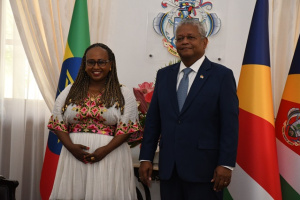
(Seychelles News Agency) - Ethiopia and Seychelles expect to further develop cooperation in trade, investments and tourism sectors, said the newly accredited Ethiopian ambassador. Etsegenet Bezabih Yimenu presented his credentials to the President of Seychelles, Wavel Ramkalawan, at State House on Tuesday morning. While in Seychelles, Yimenu will also meet Vice President Ahmed Afif and other members of the cabinet of ministers as well as the secretary general of the Seychelles Chamber of Commerce (SCCI), Oliver Bastienne. Yimenu replaces Meles Alem Tekea, who presented his credentials to President Danny Faure at State House in 2019. Seychelles, an archipelago in the western Indian Ocean, and Ethiopia established relations in April 1982.
This was noted in a statement by the Ministry of HealthDuring the three-day Ethio Health Exhibition Ministry of Health Senior Advisor Esayas Mesele said that the government is focusing on making Ethiopia a centre for medical tourism. He emphasised that this policy and strategy is important to stimulate the sector as a whole and also in attraction of investors. He noted that Ethiopian citizens travelling abroad for health care face high costs. He emphasised that one of the top priorities is to train professionals and introduce new technologies in the country's health services, which in turn will ensure quality and affordable health services in Ethiopia. The 8th ethio health exhibition and conference, the largest gathering of health professionals in East Africa.
Update RequiredTo play the media you will need to either update your browser to a recent version or update your Flash plugin.
borkenaJoel and Princess Ariana – Ethiopian Royals met in a night club in D.C. about ten years ago. Watch an interview – reflects on the imperial government of Emperor Haileselassie I – among other things. Part IPart IIVideo : embedded from Dink TV YouTube channelCover photo : screenshot from the videoEthiopian News VideoJoin our Telegram Channel : t.me/borkenaLike borkena on FacebookJoin the conversation. Follow us on X (formerly Twitter ) @zborkena to get the latest Ethiopian News updates regularly. Ethiopia Subscribe to YouTube channel To share information or for submission, send an e-mail to info@borkena.com
Anthony Blinken (Photo : Reuters/file)DELIVERED ELECTRONICALLYAn Open Letter to Anthony Blinken, United States Secretary of StateVia email to: secretary@state.govThe Honorable Antony BlinkenU.S. Department of StateOffice of the Secretary Room 7226Harry S. Truman Building 2201 C Street, NWWashington, D.C. 20520March 10, 2024RE: An act of genocide-by-proxy against the Amhara People? Several overt and covert attempts were made by the United States to cause diplomatic stampede, the flight of foreign missions out of Ethiopia. It is impossible for any peace talk effort to even begin with the Fano with Ambassador Michael Hammer as the main player. The current uprising, resistance movement of the Fano, is the direct result of the treacherous Pretoria Agreement, courtesy of the United States State Department, Ambassador Mike Hammer’s legacy. Some in the State Department, such as Michael Hammer’s advisor, have a very personal interest; having adopted children from Tigray.
The distribution of digital ID cards to Ethiopian refugees and returnees, as part of a pilot with tripartite support, has begun in the country’s capital Addis Ababa. It was unveiled last year following the signing of an MoU by Ethiopia’s ID and refugee authorities and the UNHCR. The digital ID issuance to refugees is being implemented under the UNHCR’s PING PRIMES Interoperability Gateway project, the first to be rolled out in Africa, the announcement mentions. Also, during one of the panel discussions during the MOSIP event, a UNICEF official explained how the Ethiopia digital ID project has helped them empower forcibly displaced persons in the Oromia region of the country. Article TopicsAfrica | biometrics | digital ID | Ethiopia | Fayda | identity management | refugee registration | UNHCR
(THE CONVERSATION) “Hometown associations,” also known as migrant clubs, are nonprofits formed by immigrants who are originally from the same place in their country of origin. Advertisement Article continues below this adMexican hometown associations are the most widely established. Why hometown associations matterI’m a scholar of philanthropy who has recently studied the Mexican hometown associations that support causes on both sides of the U.S. southern border. This estimate leaves out collective philanthropy, including the money that hometown associations send back to their homelands. I’ve never found a reliable estimate of the scale of hometown associations’ charitable contributions.
I consistently named the Eskinder Nega and Shaleka Dawit Woldegiorgis team as a liability to the Fano movement. He lacks political savviness, diplomatic subtlety, and moral fortitude to lead any political movement. The strategy was to use diaspora forces as a leverage to hijack the Fano movement at home. Why is Fano Stronger in Gojam Than in Other Parts of the Amhara Tribal Land? The answer to this question is key to establishing a political architecture to unify Fano across the Amhara tribal land.
Living in a rudimentarily furnished home in Ethiopia’s capital Addis Ababa, sixtysomething Sami has spent nearly two decades translating Greek mythology into Amharic. Slight in frame, the reticent figure only lights up when he speaks of his colossal project, which has grown into an all-consuming obsession. The book has overwhelmed all other aspects of his life, leaving friends, relatives and Sami’s own wellbeing in the rearview mirror. At the same time, at the launch for his long-awaited book, Sami is strangely at a loss for words, as he refuses to give a speech about his efforts. Perhaps, his ambivalence about his achievement stems from what he considers to be a wasted youth, spent in the shadow of Mengistu Haile Mariam’s regime.